Am I still me?
A question that can arise when life splits into “before” and “after.”
Enrollment for the second group (start date: October 19) is closed. Enrollment is now open for the third group, starting November 10. Participation is free.
Forced displacement changes more than where you live. It can break the familiar connection between past, present, and future: home, relationships, professional roles, familiar surroundings, and your sense of who you are and where your life is headed can all change.
Psychological research shows that after forced migration, a sense of continuity of self becomes especially important — the experience that, despite major changes, my past, present, and future still belong to one story. Reflecting on one’s experience autobiographically can help restore this connection.
Meaning in Transition is an existential-autobiographical program of seven sessions for people who have been forcibly displaced, including as a result of Russia’s full-scale invasion of Ukraine.
The program does not take people back to their previous lives. It helps them make sense of what happened, see the connection between past and present, identify what still matters, and open up the possibility of continuing their own story.
Structure
Seven sessions, seven questions
Each session addresses one question. Together, they lead from rupture to the possibility of continuing your own story.
My rupture: what happened to my story?
The first session explores what exactly was disrupted: roles, relationships, everyday life, and plans for the future.
Learn more — My rupture: what happened to my story?Am I still me?
On continuity of self: what has changed, what has remained, and what a person has discovered about themselves.
Learn more — Am I still me?What matters to me now?
On the struggle for meaning: which values have changed, and which have taken shape since displacement.
Learn more — What matters to me now?
How does the program work?
After forced displacement, life can split into “before” and “after.” We remember our past, but sometimes lose the sense of connection between who we were, who we are now, and who we might become.
In the program, we return to important events in our own story and reflect on what they changed and what has remained important to us. This helps us see the connection between past, present, and future — and understand how to continue our own story in new circumstances.
Put simply: we don’t try to bring back the old life. We help you feel again that “this is still my story.”
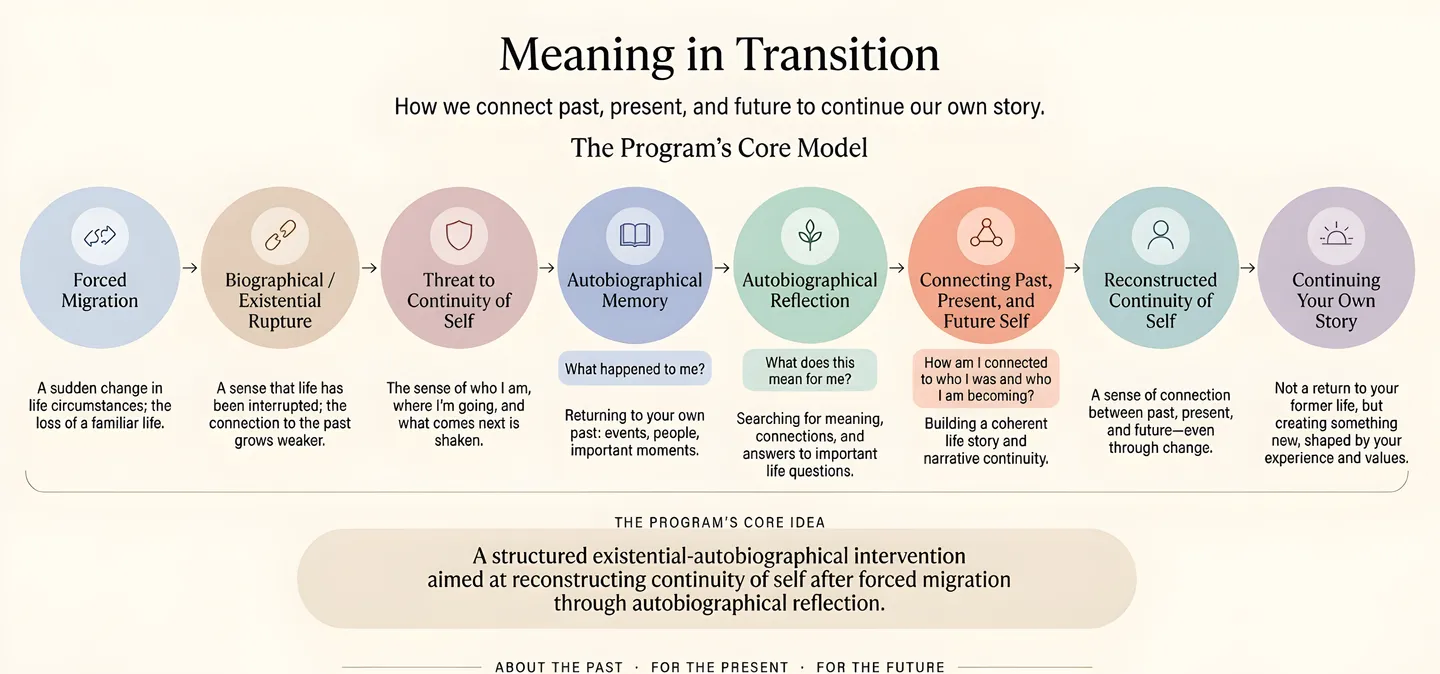
What the program offers
The program doesn’t ask you to make any particular decision about your future. It helps you understand your own experience, and the decision remains yours.
Reconnect with your own story
See displacement in the context of your whole life, and distinguish what was lost, what has changed, and what is still part of you.
Understand your own transformation
Who I was, who I have become, what changed, what remained, and what I learned about myself.
See a way to continue
Consider how life can go on, taking into account what has already happened.
An internationally recognized method
The program is based on Existential Analysis, a psychotherapy method officially recognized by the state in Austria, Germany, and Switzerland.
Continue your own story
Enrollment is open for the third group, starting November 10. Sessions are held online via Zoom, in Ukrainian.