Restoring continuity of self
Forced displacement can disrupt not only a person’s connection to place, community, and familiar ways of life, but also their sense of their own continuity. Meaning in Transition is a seven-session existential-autobiographical program aimed at restoring that continuity.
Who this program is for
The program is for adults who have been forcibly displaced and feel that their life, relationships, professional identity, sense of home, or vision of the future has changed as a result.
It may be especially helpful if you:
- feel a gap between who you were before and who you are becoming now;
- live between two countries, cultures, or ways of life;
- have lost your familiar sense of home, or feel as though you now have two homes;
- don’t know how to connect your present life with your earlier story;
- are experiencing a sense of loss — of your familiar life, home, relationships, role, or a part of yourself;
- want to understand what has changed in you, what still matters, and how to keep a sense of continuity of self in new circumstances.
What this program is not
This is not psychotherapy
Meaning in Transition is a structured group program of self-exploration and reflection. It is not psychotherapy, psychiatric care, or treatment for mental health conditions.
If you are in an acute psychological crisis or need individual psychotherapy or psychiatric care, this program does not replace appropriate professional support.
What the program explores
The program does not aim to return people to their previous lives or to who they were before displacement. Instead, it helps them explore what happened.
What was interrupted
Roles, relationships, work, social ties, everyday life, plans, and ideas about the future.
What was lost
And which of those losses continue to shape who a person is.
What changed and what remained
Telling change apart from continuity is a distinct task — and one that is rarely done consciously.
What a person discovered about themselves
Displacement reveals things people didn’t know about themselves.
What matters now
Which values and guiding principles have changed or taken shape since displacement.
How to continue your own story
What possibilities exist in the present situation, and what step is possible now.
What the program is based on
The program was developed on the basis of Existential Analysis and research on the experience of forced migration.
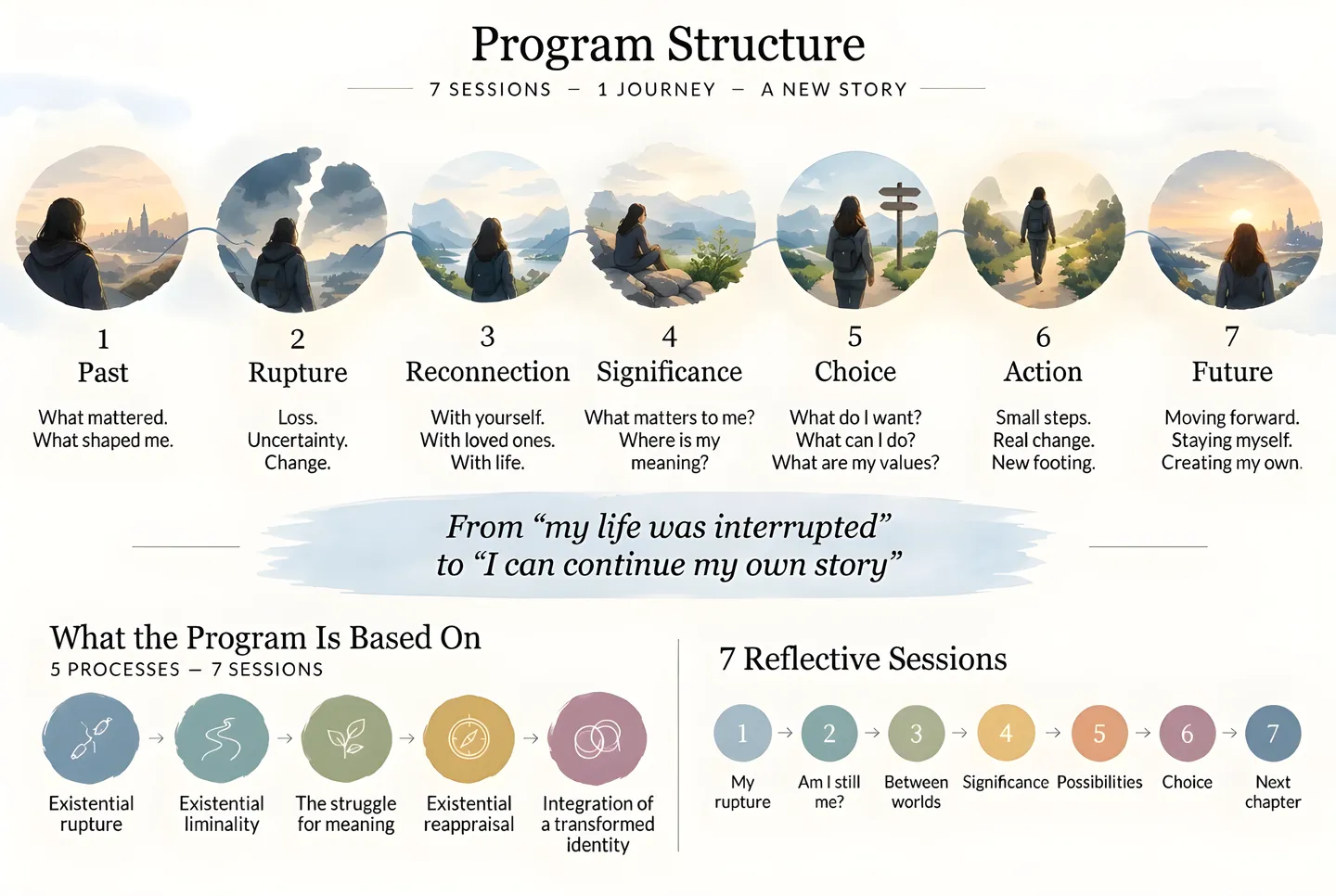
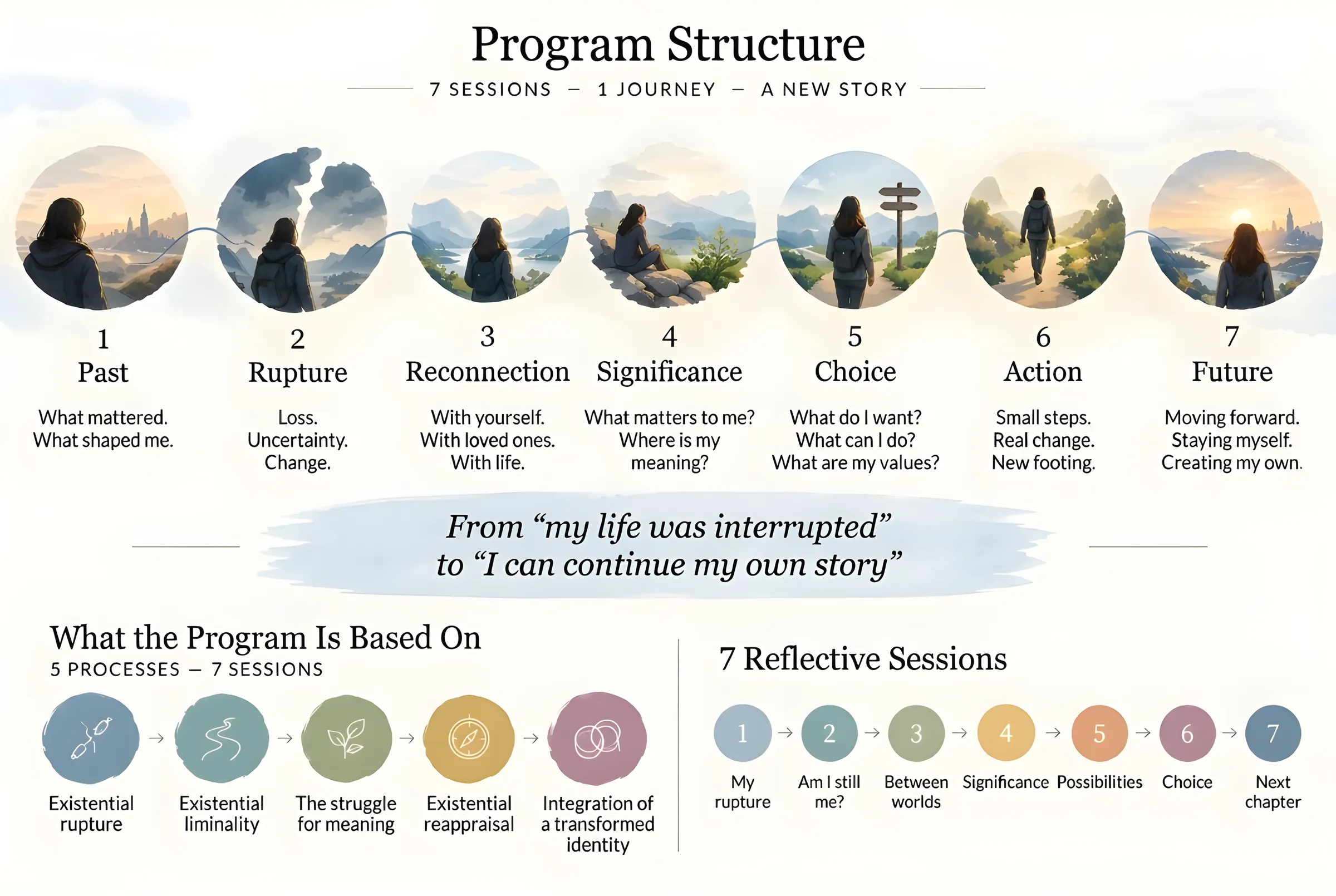
Its structure is tied to five processes that can accompany a person’s transformation after forced displacement:
- Existential rupture
- Existential liminality
- The struggle for meaning
- Existential reappraisal
- Integration of a transformed identity
These are not necessarily separate stages that everyone goes through in the same way. Rather, they are interconnected processes through which a person may rethink their experience, themselves, and their future life.
The program translates these ideas into seven sequential reflective sessions. Each session builds on the previous one and helps participants move gradually from making sense of the rupture they experienced toward the possibility of continuing their own story in new circumstances.
In theoretical terms, the program is a structured existential-autobiographical intervention aimed at reconstructing continuity of self after forced migration through autobiographical reflection.
The logic of the program
The seven sessions follow a sequence: from rupture to the possibility of continuing. Each builds on the previous one and adds the next step to this work.
- 1–2
Rupture and continuity
What happened to my story, and am I still me? Working with what was interrupted.
- 3–4
Between worlds and what matters
The state of transition and the struggle for meaning: what matters to me now.
- 5–7
Possibilities, choice, the next chapter
From reappraisal to decision and the transformation of identity.
Continue your own story
Enrollment is open for the third group, starting November 10. Sessions are held online via Zoom, in Ukrainian.